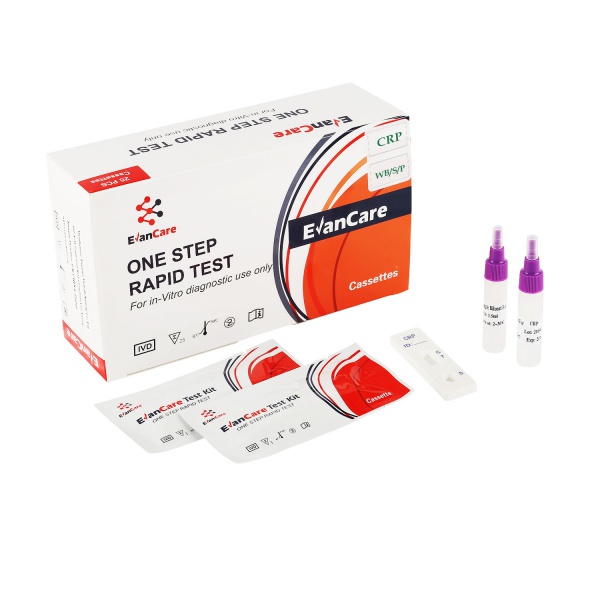
| EVANCARE CRP C-reactive Protein Rapid Test Cassette Specification |
| Catalog No. | EC-CRP1001 | Format | Cassette |
| Specimen | Whole blood/Serum/Plasma | Test/Box | 25/40 |
| Reading Time | 15 minutes | Shelf Life | 3 Years |
| Storage Temperature | 4-30°C | Specificity | >99.9% |
| Sensitivity | >99.9% | Composition | Individually packed test device, Package insert, Dropper, Buffer |
| Accuracy | >99.9% | Feature 1 | High Accuracy |
| Feature 2 | High Sensitivity | Feature 3 | Clear Results |
| Feature 4 | Easy To Read | Feature 5 | Easy To Use |
| Feature 6 | OEM/ODM Available | Feature 7 | Quality Guarantee |
EVANCARE CRP C-reactive Protein Rapid Test Cassette Test Procedure
Allow the test device and specimens to equilibrate to temperature (15-30°C or 59-86°F) prior to testing.
1. Remove the test cassette from the sealed pouch.
2. Add 3 drops of diluted sample (approx. 100μL) to the “S” well of the test cassette, and then begin timing. See the illustration below.
3.Wait for colored lines to appear. Interpret the test results in 15 minutes. Do not read results after 20 minutes.

[STORAGE AND STABILITY]
- Store as packaged in the sealed pouch at temperature (4-30℃ or40-86℉). The kit is stable within the expiration date printed on thelabeling.
- Once open the pouch, the test should be used within one hour.Prolonged exposure to hot and humid environment will cause productdeterioration.
- The LOT and the expiration date were printed on the labeling.
[SPECIMEN]
- The test can be used to test Whole Blood/Serum/Plasma specimens.
- Collect blood specimen (containing EDTA, citrate or heparin) by veinpuncture following standard laboratory procedures.
- Separate serum or plasma from blood as soon as possible to avoidhemolysis. Use only clear non-hemolyzed specimens.
- Store specimens at 2-8℃ (36-46℉) if not tested immediately. Storespecimens at 2-8℃ up to 7 days. The specimens should be frozen at-20℃ (-4℉) for longer storage.
- Avoid multiple freeze-thaw cycles. Prior to testing, bring frozenspecimens to room temperature slowly and mix gently. Specimenscontaining visible particulate matter should be clarified by centrifugationbefore testing.
- Do not use samples demonstrating gross lipemia, gross hemolysis orturbidity in order to avoid interference on result interpretation.
- Use a disposable pipette to transfer 10UL of the specimens and add tothe dilution tube with buffer (990UL).
- Bottom up and down the tube for several time to mix the specimenswell. The diluted sample can be kept at room temperature for at least 8hours.(The picture is for reference only, please refer to the material object.)
[TEST PROCEDURE]
- Allow the test device and specimens to equilibrate to temperature(15-30℃or 59-86℉) prior to testing.
- 1. Remove the test cassette from the sealed pouch.
- 2. Add 3 drops of diluted sample (approx. 100UL) to the “S” well of the testcassette, and then begin timing.See the illustration below.
- 3. Wait for colored lines to appear.
Interpret the test results in 15 minutes.Do not read results after 20 minutes.(The picture is for reference only, please refer to the material object.)
[INTERPRETATION OF RESULTS]
Positive: Three lines appear. Both C line and R line should always appear,and the T line is equal to or darker than the R line.
Negative: Both C line and R line should always appear, and no line appearsin the T region, or the T line appears but is lighter than the R line.
Invalid: C line or R line fails to appear. Review the procedure and repeat thetest with a new test cassette. If the problem persists, discontinue using thetest kit immediately and contact your local distributor.